

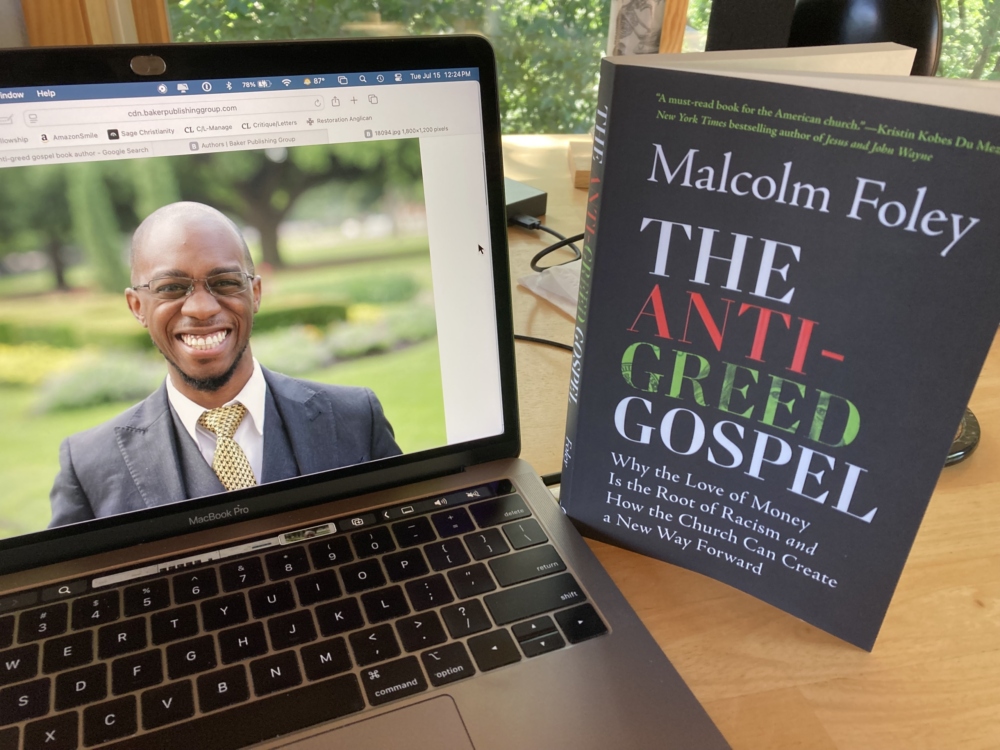
This accessible, brief book is an interesting addition to the literature on a Christian view of racism. It is also a bracing study of the biblical teaching concerning covetousness.
Dr. Malcolm Foley, pastor and educator (Baylor University), probes the sin of American racism and insists that at its root is greed. Foley summarizes his argument this way:
Race is not primarily about hate and ignorance. It’s about greed. It always has been. And the purpose of this book is that you might understand the unholy relationship between race and greed, best understood not as a marriage but in terms of parentage: race and racism are children of Mammon. [p. 1-2]
Foley begins his book with a quote from one of the Church Fathers. This is from John Chrysostom’s (died 407 AD) sermons on the Gospel of St John.
Perhaps one of you will say, “Every day, you talk about covetousness.” Would that I could speak about it every night too; would that I could do so, following you about in the market-place, and at your table; would that both wives, and friends, and children, and domestics, and tillers of the soil, and neighbors, and the very pavement and walls, could ever shout forth this word…. For this malady hath seized upon all the world, and occupies the souls of all, and great is the tyranny of Mammon.
Do you find it difficult to take the subject of greed or covetousness seriously? I do. For one thing, we live in a capitalist society where consumerism is a mark of success and progress. Besides, a trip to the mall can be cathartic after a hard week. My first impression as I read The Anti-Greed Gospel was how innocuously I take the biblical warnings about covetousness. Yeah, it’s a sin, but we don’t run up debt, we tithe, we live within our means, and we don’t swap our car in regularly for the latest model, so what’s the problem? Besides, what is greed and what is merely shopping? Do I need to wait for something to break before replacing it with the newest model?
As Foley points out, St Paul warned in Colossians 3:5 that greed is idolatry, so it is primarily an issue of the heart. Dealing with it takes deeper conviction, a deeper dive into what we most love, what makes us feel most secure, what we yearn for, believing that if we only had ________, we’d be satisfied. Contented. And much of what we put in the blank is good. Like “paying off the mortgage,” or “taking an extended vacation in Europ to deepen our love of Renaissance art.”
Two of the Great Doctors of the Eastern Church, Basil the Great and John Chrysostom, are the best resources for the body of Christ on this point: greed does not merely lead to theft. Greed is theft…
Basil, preaching on the conversation between Jesus and the rich young ruler, views the young man’s sin as greed, understood as a failure to love his neighbor as himself. Affirming that “care for the needy requires the expenditure of wealth,” Basil utters a heart-stopping line in his sermon, aptly titled To the Rich: “The more you abound in wealth, the more you lack in love.” Basil, in his particular context, sees that the Scriptures frame a world in which accumulation almost always happens at someone else’s expense, and that person is often needy. Thus, the more you have and hold, the less you love your neighbor.
Basil here gives the reason for Christian generosity: it is not an extra nice-to-have element of the Christian life; rather, it is a fundamental act of obedience to the Great Commandments and, particularly, to the eighth and tenth commandments. It is difficult to steal and covet when your primary relationship with goods is thinking of how they can be redistributed to meet needs. None of this denies familial obligation, but it does remind us that love of neighbor requires redistribution, not just a different attitude about money.
Chrysostom similarly calls us to lives of simplicity rather than luxury, specifically so that we have enough to give. In fact, Chrysostom, like Basil, marshals the Scriptures to show that “not only the theft of others’ goods but also the failure to share one’s own goods with others is theft and swindle and defraudation.” The only reason God allows us to have more, Chrysostom argues, is so that we will distribute our surplus to those in need. The story of race, however, is a narrative that allows people to accumulate more in order to increase power and influence, not for the sake of the common good but for the sake of selfish ambition. [p. 20-21]
The Anti-Greed Gospel has two major themes. The first is to demonstrate from history that American racism—exhibited in slavery and lynching—was motivated by greed. That greed continues on, Foley argues, in the blatant consumerism that rules our society and tempts us to purchase and accumulate. The second theme is to demonstrate the biblical condemnation of covetousness, greed, and idolatry. And how Christ’s church can, by recovering the biblical emphasis on greed and faithfully believing and preaching the Gospel—which is anti-greed—chart a different path into the future.
Book Recommended: The Anti-Greed Gospel; Why the Love of Money Is the Root of Racism and How the Church Can Create a New Way Forward by Malcolm Foley (Grand Rapids, MI; 2025) 166 pages + notes.
As always, we recommend you order this book from Hearts and Minds Books.
Photo credit: The author with his iPhone and laptop.

