

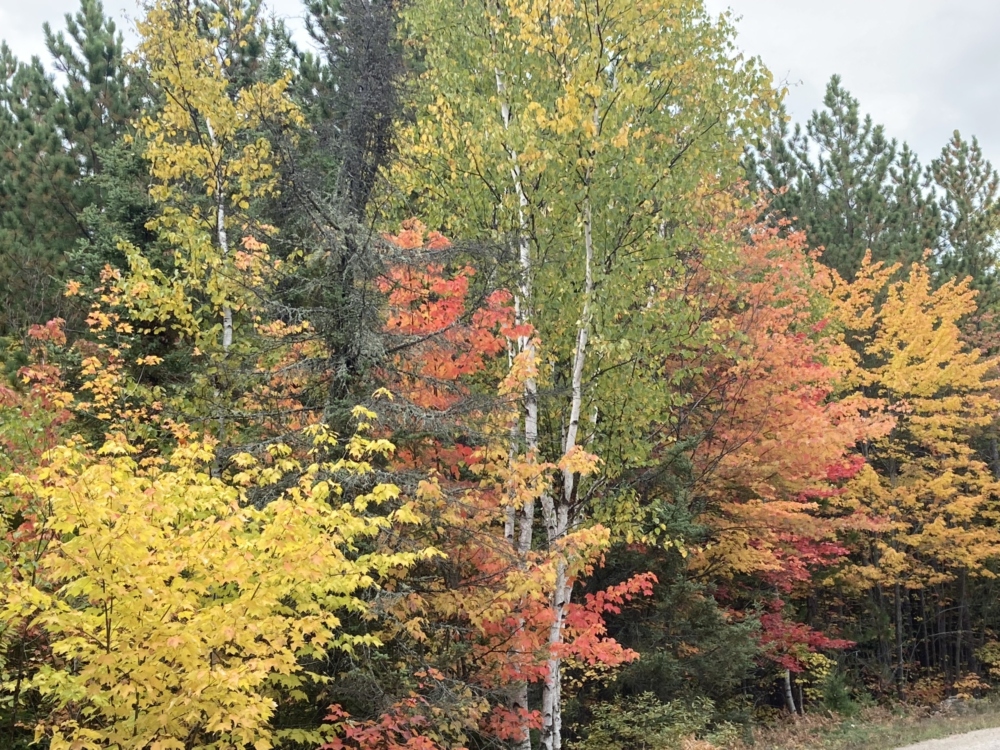
Photo: Fall
Temperatures have begun to drop, hummingbirds have left for warmer spots, and trees have burst into color. After a lovely summer with a myriad flowers blooming in our yard (thanks to Anita’s love of gardening) it’s as if the glorious color of creation has changed places. From flowers to grasses, shrubs, and especially trees.
I’ve read enough botany to have a rough idea of how and why the colors of the leaves change. And why different trees sport different fall colors, from the reds of maples to the yellow of lindens and the brown of oaks. It’s a process involving death and decay, part of the annual transition from summer to autumn to winter. It is, without doubt, a natural phenomenon. To suggest that’s the full extent of what’s going on, however, is to display, it seems to me, an alarming lack of imagination. Does not the sense of wonder, of awe, hint there might be more? If it was merely natural molecular change evolutionary theory would suggest that after millennia of living with it we would hardly notice. Beyond the sign of changing seasons, that is, because that involves survival. But the sense of awe would make no sense.
No, there is more. Something deep within our humanity responds to it with joy.
God goes, belonging to every riven thing he’s made
sing his being simply by being
the thing it is:
stone and tree and sky,
man who sees and sings and wonders why
[From “Every Riven Thing” by Christian Wimen]
Natural science is wonderful, a gift of God. But a naturalist perspective of reality is not. More complete is a Christian perspective, a sacramental view of reality. Sacraments are outward physical signs of an inward spiritual grace, where God makes himself present in creaturely things. We see this in the Sacraments of the Church, in Baptism and the Eucharist. The bread is Christ’s body, broken for us, and the wine his blood, the cup of salvation. A sacramental view of creation does not suggest trees are a sacrament, but that seeing the autumn colors sacramentally allows us to catch a glimpse of the Creator’s glory and majesty in the things he has made.
Outside my office window as I type this, a north wind is blowing briskly. Yellow and brown leaves are being dislodged, soaring, gliding to the ground. It’s very noisy in a lovely way, leaves slapping leaves, branches vibrating, wind moving where it will.
For you shall go out in joy,
and be led back in peace;
the mountains and the hills before you
shall burst into song,
and all the trees of the field shall clap their hands.
[Isaiah 55:12]
That hopeful day is still in the future, but I enjoy an anticipatory hint today of what it might be like.
Then a sacramental view will be the only possible perspective. Until then, our culture seeks to infect us with a reduced, naturalistic one. That’s like (to use an image from C. S. Lewis) to refuse a trip to the beach to play in a sandbox.
O heavenly Father,
you have filled the world with beauty:
Open our eyes to behold your gracious hand in all
your works; that, rejoicing in your whole creation,
we may learn to serve you with gladness;
for the sake of him through whom all things were made,
your Son Jesus Christ our Lord.
Amen. [Book of Common Prayer, Occasional Prayers 21]
Photo credit: Taken by the author with his iPhone.

